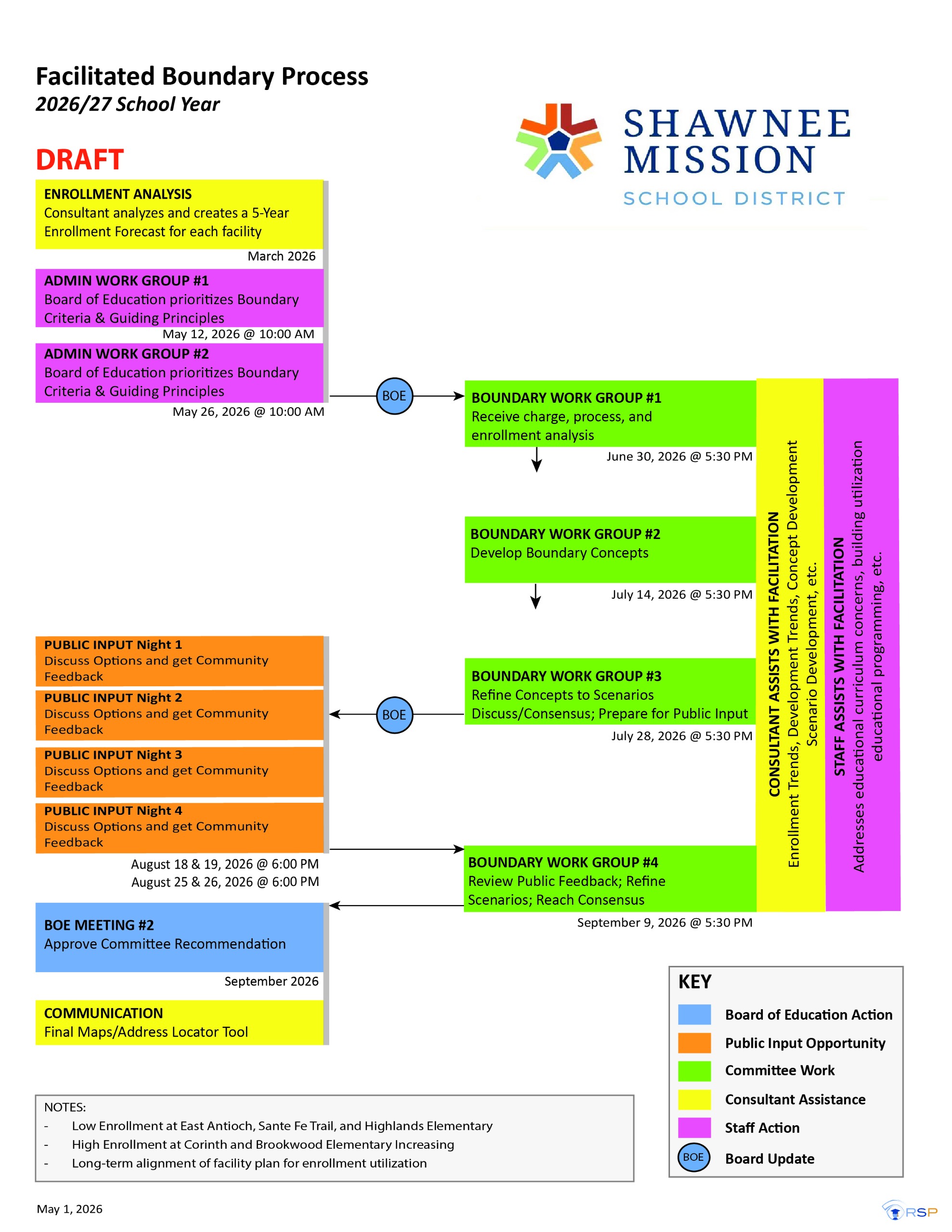
Comprehensive Boundary Process
Process Fast Facts
The SMSD Boundary Work Group agrees to the following guiding principles, which will inform the boundary recommendation presented at the conclusion of this process:
1. Boundary adjustments should maximize utilization of existing facilities (targeting efficient capacity ranges) and promote long-term financial sustainability without creating unnecessary operational costs.
2. Boundaries should be designed to anticipate and accommodate future residential growth, allowing developing areas to grow into available capacity and supporting long-term enrollment stability.
3. Boundaries should support equitable access to educational opportunities, programs, and resources so that students across all schools have a consistent and high-quality educational experience.
4. Where possible, boundaries should respect neighborhoods and community identity, supporting the neighborhood school concept while balancing broader district needs.
5. Consideration should be given to natural and man-made boundaries (e.g., major roads, railroads) to create clear, logical, and easily understood attendance areas.
6. Boundaries should promote reasonable demographic balance across schools, supporting diversity and ensuring a comparable student experience district-wide.
7. Grandfathering, transfer options, and student placement decisions will be determined by administration to support smooth implementation and address unique circumstances.
8. The district will maintain its current grade configuration of K-6 elementary schools, 7-8 middle schools, and 9-12 high schools.
- Review attendance boundaries to balance enrollment between Low Enrolled and High Enrolled schools
- Align with Action Team 6.1.2 Bond Recommendations (in progress)
- Improve balance, longevity, and feeder alignment
1. Feeder System: Ensure as many schools have students move from one grade level to maximize student connectivity
2. Projected Enrollment: Balanced, logical enrollment that works within the confines of school capacities
3. Duration of Boundaries: Boundaries remain the same for as long as possible
4. Fiscal Considerations – Operational: Minimize additional staffing costs across schools
School Utilziation Resources:
-
 Research Summary #1PDF (68.62 KB)
Summary of enrollment thresholds from various sources
-
Research Summary #2PDF (83.77 KB)
Summary of enrollment thresholds from various sources
-
Capacity Utilization Standards DescribedPDF (111.29 KB)
Chicago Public Schools
-
Elementary School Size and Student Performance: A Conceptual AnalysisPDF (286.74 KB)
Zoda, P., Combs, J. P., & Slate, J. R. (2011).
Elementary school size and student performance: A conceptual analysis. International Journal of Educational Leadership Preparation, 6(4). -
Optimal Context Size in Elementary Schools: Disentangling the Effects of Class Size and School SizePDF (279.31 KB)
Ready, D. D., & Lee, V. E. (2007).
Optimal context size in elementary schools: Disentangling the effects of class size and school size. In T. Loveless & F. M. Hess (Eds.), Brookings Papers on Education Policy, 2006/2007 (pp. 99–135). Washington, DC: Brookings Institution Press.