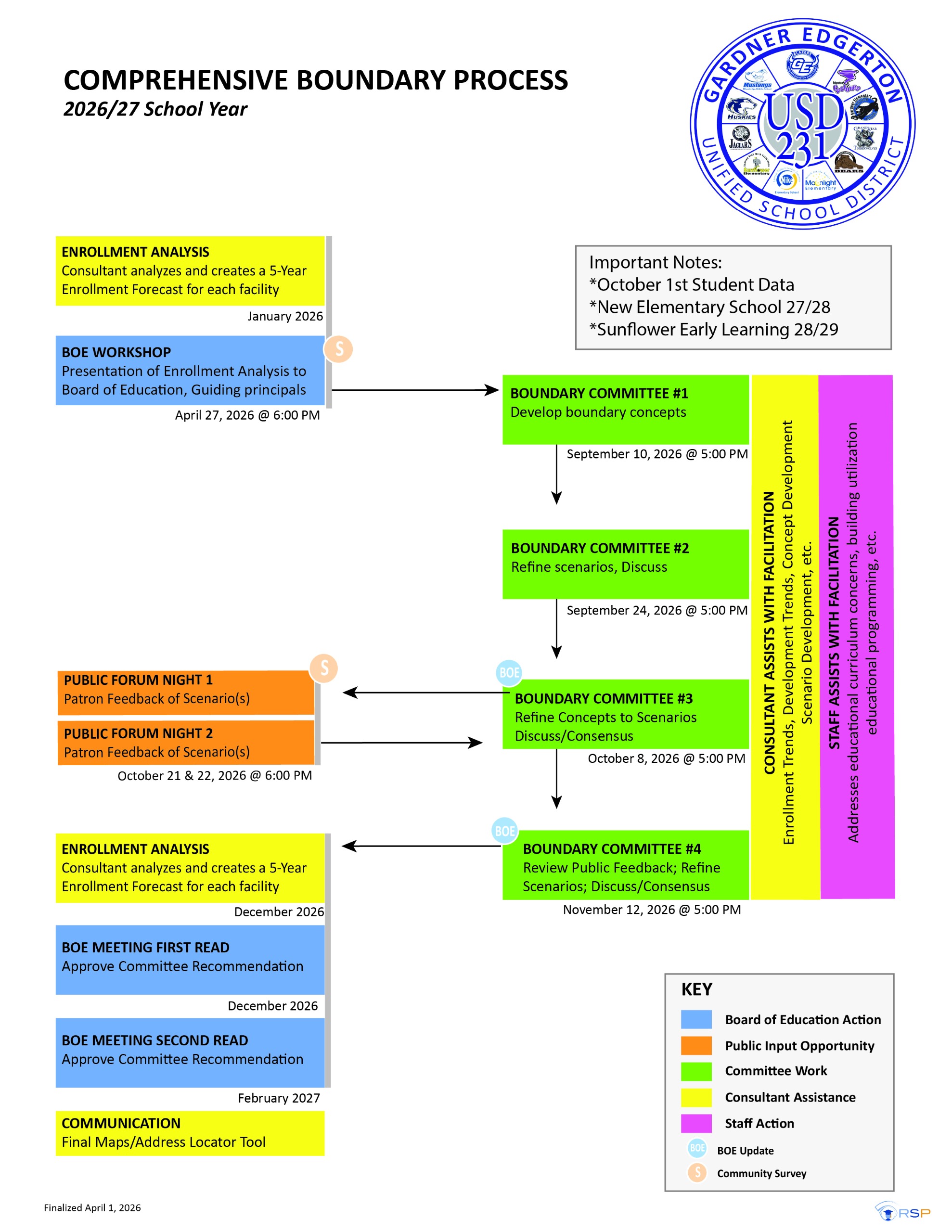
Comprehensive Boundary Process
Thank you for your time and partnership in this important process. This effort is a transparent, committee-led review of elementary and middle school attendance boundaries, aligned with the 2025 Bond projects.
As our community continues to grow and evolve, it is necessary to revisit attendance boundaries to ensure balanced enrollment, efficient use of capacity, and long-term stability for our schools.
This website is designed to provide clear information about the process, key considerations, and ongoing updates. It will serve as a central resource for committee members and the broader community throughout this work.
Process Fast Facts
The USD 231 Board of Education agree to the following Guiding Principles that will factor in some way into the boundary recommendation presented to the Board at the conclusion of the process:
1. All the Boundary Criteria are important – generally believe an unstated result of the boundary changes are to balance enrollment with the capacity of the school, as well as not adding additional fiscal costs for buildings or staffing.
2. The boundary can anticipate and accommodate future growth of the neighborhood (allow areas of growth to grow into capacity of the school).
3. Consider boundary lines that follow natural/manmade boundaries (railroads, interstate) while maintaining and promoting the neighborhood school concept.
4. Grandfathering/Transfers/Student Options are determined by Administration.
5. The boundary should reflect providing better educational opportunities at each school for there to be an equitable student experience at each school.
6. The committee recognizes the power of a neighborhood to create community and boundaries.
7. The boundary proposed should utilize all of the available district resources; do not increase capital costs to increase capacity.
8. Demographics should allow reasonable equity and similar student experience at each school.
9. Prioritize an effective feeder; if a feeder has to be split that split should redistrict large groups of students not just a few to ensure a positive transition.
10. The grade configuration should remain Kdg to 4th grade, 5th to 8th grade, and 9th to 12th grade.
11. Committee recognizes specialized programs should align with the feeder to provide students continuity and stability.
- Establish an elementary school boundary for the Future Elementary School
- Redistribute Sunflower Elementary School boundary to other schools to support the transition to Sunflower Early Learning Center
- Improve balance, longevity, and feeder alignment in the elementary and middle school boundaries
1. Feeder System: Ensure as many schools have students move from one grade level to maximize student connectivity
2. Projected Enrollment: Balanced, logical enrollment that works within the confines of school capacities
3. Duration of Boundaries: Boundaries remain the same for as long as possible
4. Fiscal Considerations – Operational: Minimize additional staffing costs across schools
- 2027/28 - opening of Future Elementary School; boundary change implemented.
- 2028/29 - opening of Sunflower Early Learning Center; no change to boundaries.